ASTRO-TECH AT66ED Refractor Telescope Telephoto Lens
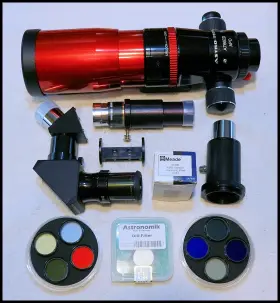
( Brand: Astro-tech ), ( Manufacturer Part Number: AT66ED ), ( Model: ASTRO-TECH AT66ED ), ( Type: Refractor ), ( Mount Type: Unmounted ), ( Features: Dew Shield, Lens Cover ), ( Aperture: 66mm )
Review ASTRO TECH Refractor Telescope Telephoto Lens And Various Accessories
The Astro-Tech AT66ED apochromatic refractor telescope telephoto lens is an exceptional piece of optics engineered for both astronomical observation and terrestrial photography. This versatile instrument boasts a 66mm objective lens made of extra-low dispersion (ED) glass, minimizing chromatic aberrations for superior image quality.
The telephoto capability of the AT66ED is achieved through its 2X Barlow lens, which doubles the effective focal length while maintaining the optical quality of the system. With a focal length of 1320mm (660mm for the objective lens), this lens allows you to capture a larger field of view and bring distant objects closer.
The lens barrel is constructed from high-quality aluminum, keeping the weight manageable while providing rigidity and durability. The lens features a 2-inch (50.8mm) focus tube, accommodating a wide range of eyepieces and accessories. The focuser is a Crayford-style design, renowned for its smooth and accurate focusing action.
The AT66ED comes with a 1.25-inch (31.8mm) adapter, allowing use with a variety of 1.25-inch eyepieces and accessories. The lens also includes a dew shield to protect the objective lens from moisture and condensation, ensuring optimal performance in various weather conditions.
This telescope lens offers excellent image clarity and contrast, making it an excellent choice for astrophotography, lunar and planetary observation, and even terrestrial photography. Its versatility, combined with its exceptional optical quality, makes the Astro-Tech AT66ED apochromatic refractor telescope telephoto lens an essential addition to any serious optics enthusiast's collection.
The Astro-Tech AT66ED apochromatic refractor telescope and a telephoto lens are two distinctly different types of optical equipment, each designed for specific purposes. Let's discuss the pros and cons of each and provide a conclusion on whether it would be beneficial to combine them.
Astro-Tech AT66ED Refractor Telescope: Pros:1. High-quality optics: This telescope features an ED (Extra-Low Dispersion) glass element that reduces chromatic aberration, providing sharper and clearer images.
2. Wide field of view: With a 66mm objective lens, this telescope offers a larger field of view than many other refractor telescopes, making it suitable for observing larger areas of the night sky.
3. Portability: Refractor telescopes are generally more portable than other types of telescopes due to their compact size and lack of moving parts.
Cons:1. Limited magnification: Refractor telescopes have a limited magnification capability due to diffraction limits, which can make observing faint details challenging.
2. Light gathering ability: A 66mm objective lens gathers less light than larger telescopes, making it less suitable for observing faint objects or very dim areas of the sky.
3. Expensive: High-quality refractor telescopes like the AT66ED can be quite expensive.
Telephoto Lens: Pros:1. Versatility: Telephoto lenses are suitable for various types of photography, including landscape, wildlife, and astrophotography.
2. Magnification: Telephoto lenses offer greater magnification than the human eye, allowing for closer observation and detail in images.
3. Interchangeable: Telephoto lenses can be used with different camera bodies and other lenses, making them a versatile addition to a photography kit.
Cons:1. Size and weight: Telephoto lenses can be quite large and heavy, making them less portable than other types of lenses or telescopes.
2. Cost: High-quality telephoto lenses can be quite expensive, especially those with advanced features and long focal lengths.
3. Difficulty in use: Astrophotography with a telephoto lens requires a stable mount and tracking system to account for Earth's rotation, making it more challenging than using a dedicated telescope.
Conclusion:Combining an Astro-Tech AT66ED refractor telescope and a telephoto lens for astronomy might not be the most practical choice due to their distinct purposes and limitations. While the refractor telescope offers a larger field of view and high-quality optics for visual observation, the telephoto lens provides greater magnification for photography. However, the use of a telephoto lens for astrophotography requires a stable mount and tracking system, which would add complexity and cost to the setup.
If you're primarily interested in visual observation, the Astro-Tech AT66ED refractor telescope would be a better choice. On the other hand, if you're looking for astrophotography capabilities, investing in a dedicated telescope and a high-quality camera lens would be more beneficial.
Details:
I have no experience with this equipment. Any questions asked, I will answer as best can. I am selling them as a favor for his widow she has no interest in keeping any of the items. Hence virtually all the equipment is in excellent condition and many cases has been only slightly used.
My friend did portrait work, Technical work and custom macro scientific. Included are a 45 degree view finder, various filters, camera adaptor for Nikon bodies, 2 eyepieces and polarize. See photos for details. I've tested all the equipment as best I could with a friends Nikon bodies and appear in fine working order.
With 66mm of clear aperture and a focal ratio f/6 EFL 400mm, the AT66 is very small light. My friend took excellent care of all his equipment and was meticulous as to keeping it clean stored properly. At only 3.9 pounds and with a fully retracted tube length of just under 12 inches, it is easily mounted on reasonably sturdy photo tripod or lightweight alt-azimuth equatorial mount. This and listings for Nikon lenses film digital are from a friend who recently passed away.
The items are listed with a low reasonable starting price. We shared most photo and outdoor interests. This listing is for an Astro-Tech AT66ED Refractor Telescope Telephoto lens and various accessories. Usually signature required for safety and to avoid porch pirates.
specifications telescuper:
- brand: Astro-tech
- mpn: At66ed
- model: Astro-tech At66ed
- type: Refractor
- mount type: Unmounted
- features: Dew Shield, Lens Cover
- aperture: 66mm
general telescuper:
- Cameras Photo > Binoculars Telescopes > Telescopes
- condition: Used
shipping telescuper:
- transit: 4-10 Days
- cost: $30.00
- type: Fixed
- class: Expedited
- carrier: USPS
- service: USPS Priority Mail
payments telescuper:
- other
- wallet: Apple-pay
- credit card: Discover
seller telescuper:
- rating: 100.0%
- # reviews: 1147
- city: New Tripoli, Pennsylvania
returns telescuper:
- policy: No Returns
offer telescuper:
- availability: In Stock
- sold: 0
- options: Ship-to-home
- quantity: 1
- started: May 5, 2025
Astro-tech AT66ED Is Similar To:
- Svbony Sv503 80ed F7 Telescope Refractor Ota Astro Professional Semi Achromatic (34.9% similar) The result is a dramatic improvement in both color fidelity and brightness the elimination of flare ghost images. This very special SV503 telescope provides , visual observers or nature watchers with bright, wide field views when observing starry skies watching. Ultra-wide band...(May 16th, 2024)
- Meade 0605-04-21 Etx-60 Digital Astro Telescope Autostar Computer Controller And Lens Cover (33.7% similar) It makes it easy to learn the stars and names as its designed point accurately them; even while in doors. Its perfect for beginners and experienced astronomers alike. The auto star computer controller and lens cover make it easy to use protect your lens, while the alt azimuth mount type provides a...(May 19th, 2024)
- Orion 9814 Starblast 4.5 Astro Reflector Telescope For Beginner Compact Portable Travel (35.6% similar) Buy happy!, here is a entry level star scope from Orion called the stablest. Still in the original packing, both eye pieces and rest of parts are still box. Did not ever take it out and set up to look at the stars or moon. When I got this thought would use it a lot, living away from the city...(May 26th, 2024)
- Specilite Sp-tr70400 Telescope For Adults And Kids 70mm Aperture 400mm Refractor Astro (39.3% similar) Easy to install and use - telescope has a complete set of paper and video installation guidelines, so you don't have to worry about any installation issues. After aligning the target for observation, adjust focus of eyepiece by turning focusing knobs. Whether you're on a trip, camping, or just...(July 4th, 2024)
- Meade 709942351965 Etx 90 Astro Telescope Premier Edition With Autostar And Eyepieces (39.5% similar) Excellent condition very clean and well cared for. Unfortunately even despite our best testing and shipping practices, issues due pop up on a rare basis...(July 14th, 2024)
- Bausch And Lomb 61-6400 Telescope Cassegrain Criterion 4000 Astro Optical Tube 1984 Usa (35.6% similar) This Busch and limb telescope is a rare find for any stargazing enthusiast. The criterion 4000 astro optical tube, manufactured in the USA 1984 , boasts a 102MM aperture and maximum magnification of 140X. Selling as is. The telescope is fully coated and has a lens coating that ensures...(July 30th, 2024)
- Astro-tech At125edl Astro-tech Optical Tube (49.2% similar) Beautiful condition AT125EDL, not a scratch or mark on it. Amazing views of planets and clusters with no chromatic aberration. Its like new other than a tiny bit of dust on objective. It just costs to...(August 20th, 2024)
- Celestron 803096703400 Astro Fi 102 Wi-fi Maksutov Wireless Reflecting Telescope Black 22202 (39.1% similar) Getting ready to observe is quick and painless thanks Palestrina's award-winning sky technology. When you find an object you'd like to view, tap the screen. Your astro fie telescope automatically slews to the object, while screen displays information about it. The astro fie 102MM majestic...(August 21st, 2024)
- Bushnell 78-9525 Astro Terrestrial Telescope (35.1% similar) Bushnell astro terrestrial telescope model 78-9525...(September 1st, 2024)
- Galileo Fs-90 800 X 90mm Astro terrestrial Telescope-nib (33.6% similar) Assume normal, minor use marks and wear unless item is described as mint or new. Instructions. 1.25 inch metal helical rack. Altitude azimuth slow motion controls. 800X 90MM astro/terrestrial reflection telescope. This fee is include din the shipping cost. 800MM optical...(October 20th, 2024)
- Bushnell 78-5500 Retro Banner Astro 280 Telescope (33.8% similar) Nice beginner telescope. Bought this from a buddy, he had it in the 80S and told me was very well taken care of...(October 27th, 2024)